Google Talk, Google’s messaging and VOIP application, is now Video enabled with a new plug-in from Festoon. Using the video plug-in, Google Talk users can now see who they are talking to, in real time. Festoon, which also has the most popular video plug-in for Skype with more than 2.75 million downloads, allows Google Talk users to talk to and see each other, play games, share pictures, or conducting business.
By installing the Festoon Google Talk Video Plug-in, Google Talk users can securely conduct video voice calls in groups from 2 to 200 and share photos, spreadsheets, presentations, or applications with others on a call. Festoon offers high-quality group voice utilizing the industry leading GIPS audio codec used also by Google Talk, Skype, and AIM Triton. Festoon’s Video plug-ins are advertiser supported.
Sunday, November 6, 2005

Friday, November 4, 2005
Google AdSense Referral program: one dollar for a new Firefox user
Google launched AdSense referral program. Referrals is a feature of AdSense that allows you to increase your revenue, while increasing your users' awareness of useful products and services. By adding a referral button to your site, you can direct users to products like AdSense and Firefox + Google Toolbar. When your referral connects a user to AdSense or Firefox, you can generate more earnings while helping new web publishers monetize their websites or improve their web browsing experience.
When a user you've referred to AdSense first earns US $100, Google will credit your AdSense account with US $100. When a user you've referred to Firefox plus Google Toolbar runs Firefox for the first time, you'll receive up to $1 in your account, depending on the user's location.
When a user you've referred to AdSense first earns US $100, Google will credit your AdSense account with US $100. When a user you've referred to Firefox plus Google Toolbar runs Firefox for the first time, you'll receive up to $1 in your account, depending on the user's location.
Bill Gates on the future of the PC
Computer users are increasingly turning to new devices for accessing key applications and information. PDAs, mobile phones, even digital TV, are all changing attitudes towards the ubiquitous PC. But, not surprisingly, Microsoft chairman Bill Gates still sees the PC – albeit a very different one – as the future.
"The PC will be able to recognise speech, you will be able to use ink with it, and it will have a camera capability so it can see what is going on," he says.
"The tablet form factor will be something you just take with you to meetings. There is a lot to be done. The PC will be a phenomenal device compared with what it is now."
More at: Bill Gates exclusive interview.
"The PC will be able to recognise speech, you will be able to use ink with it, and it will have a camera capability so it can see what is going on," he says.
"The tablet form factor will be something you just take with you to meetings. There is a lot to be done. The PC will be a phenomenal device compared with what it is now."
More at: Bill Gates exclusive interview.
Thursday, November 3, 2005
Google Desktop 2 out of beta
Google Desktop 2 and Google Desktop for Enterprise have emerged from beta testing and can now be considered full-fledged software. In a sure sign that the search software has finally arrived, Google Desktop has its own blog.
Google Desktop 2, a free downloadable application, combines desktop search and the Google Sidebar, a floating tool palette that offers personalized news and other information based on a user's habits.
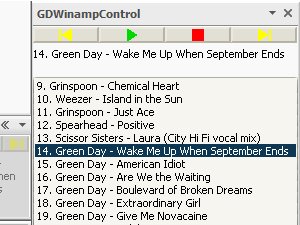
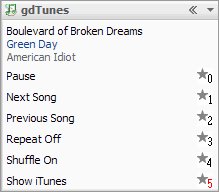
Dozens of new third-party Sidebar panels are now available like iTunes, Winamp control and an American Express panel to track and view credit card transactions in real time. The new software can also display maps related to the sites one visits while surfing the Net.
In addition, developers can use simple JavaScript to write plug-ins for Google Desktop 2.


Google Desktop 2, a free downloadable application, combines desktop search and the Google Sidebar, a floating tool palette that offers personalized news and other information based on a user's habits.
Dozens of new third-party Sidebar panels are now available like iTunes, Winamp control and an American Express panel to track and view credit card transactions in real time. The new software can also display maps related to the sites one visits while surfing the Net.
In addition, developers can use simple JavaScript to write plug-ins for Google Desktop 2.
Wednesday, November 2, 2005
Web 2.0
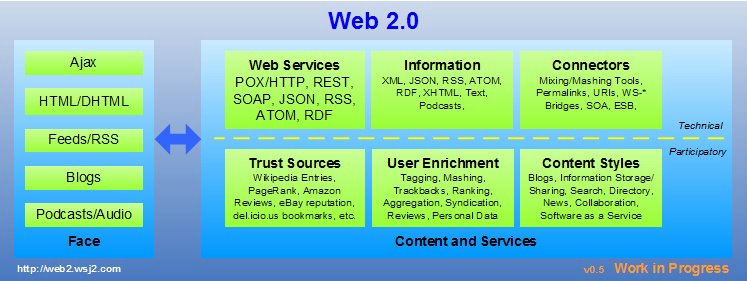
Great O'Reilly article that tries to define Web 2.0.
One of the most highly touted features of the Web 2.0 era is the rise of blogging. Personal home pages have been around since the early days of the web, and the personal diary and daily opinion column around much longer than that, so just what is the fuss all about?
At its most basic, a blog is just a personal home page in diary format. But as Rich Skrenta notes, the chronological organization of a blog "seems like a trivial difference, but it drives an entirely different delivery, advertising and value chain."
One of the things that has made a difference is a technology called RSS. RSS is the most significant advance in the fundamental architecture of the web since early hackers realized that CGI could be used to create database-backed websites. RSS allows someone to link not just to a page, but to subscribe to it, with notification every time that page changes. Skrenta calls this "the incremental web." Others call it the "live web".
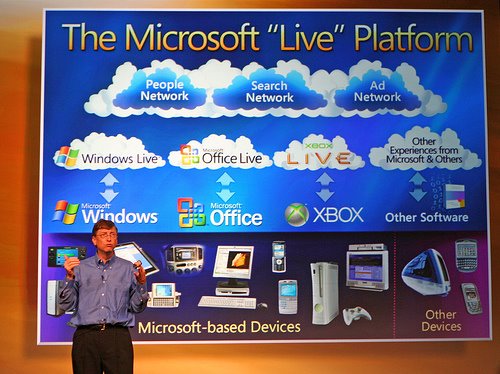
Windows Live on Live.com
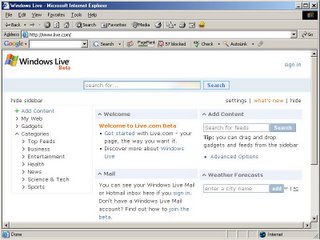
Bill Gates announced Windows Live and Office Live. Windows Live homepage looks underwhelming in Internet Explorer, and is broken in Firefox.
So now on Live.com we have weather forecasts, stock quotes, email, horoscopes, an RSS reader. You can drag & drop and expand & collapse sections to your liking, and if you’re logged in, you can also see your new Hotmail messages right on the front-page .
As soon as we see MS Word, MS Excel, and MS PowerPoint as actual working (D)HTML pages (Q1 of 2006), this could become interesting.
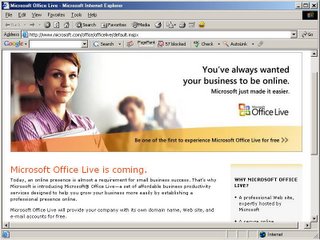
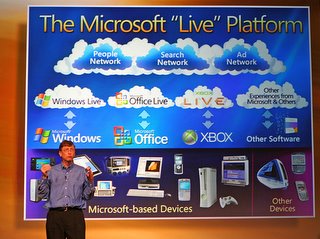
More at: Crunchnotes.com
So now on Live.com we have weather forecasts, stock quotes, email, horoscopes, an RSS reader. You can drag & drop and expand & collapse sections to your liking, and if you’re logged in, you can also see your new Hotmail messages right on the front-page .
As soon as we see MS Word, MS Excel, and MS PowerPoint as actual working (D)HTML pages (Q1 of 2006), this could become interesting.
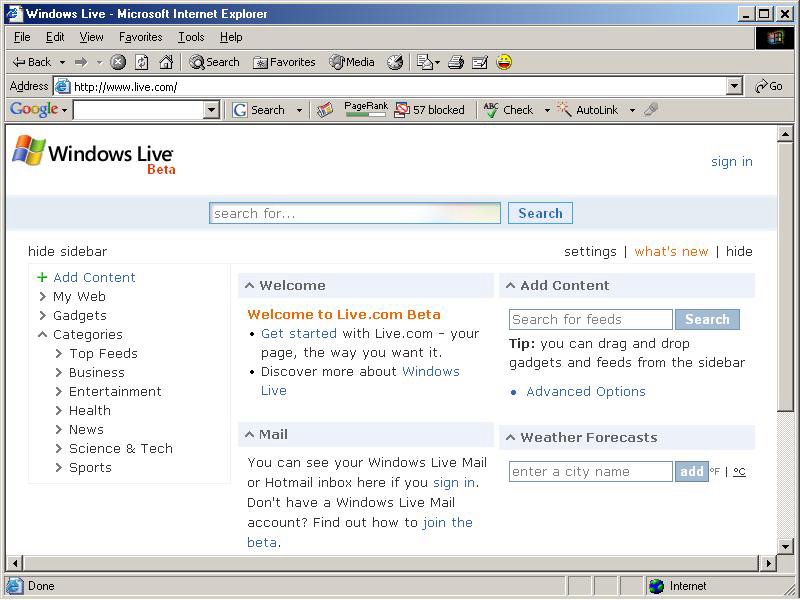
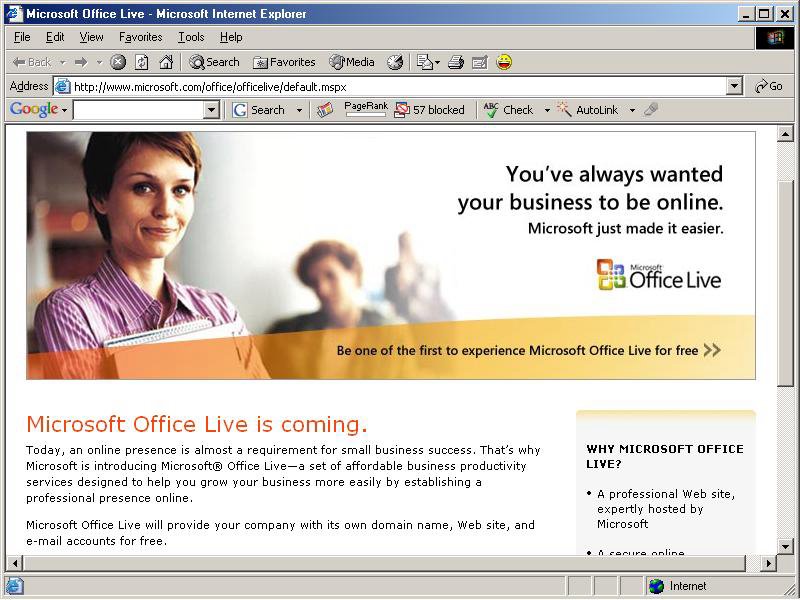
More at: Crunchnotes.com
Tuesday, November 1, 2005
Google tweaks OpenOffice
OpenOffice has its roots in Sun Microsystems' StarOffice suite of programs. Five years ago, Sun turned its proprietary software into an open-source project. Only recently, however, has the competitor to Microsoft's Office attracted serious attention.
Now Google believes it can help OpenOffice--perhaps working to pare down the software's memory requirements or its mammoth 80MB download size, said Chris DiBona, manager for open-source programs at the search company.
Google's manager for open-source programs Chris DiBona told news.com: "We want to hire a couple of people to help make OpenOffice better."
Now Google believes it can help OpenOffice--perhaps working to pare down the software's memory requirements or its mammoth 80MB download size, said Chris DiBona, manager for open-source programs at the search company.
Google's manager for open-source programs Chris DiBona told news.com: "We want to hire a couple of people to help make OpenOffice better."
Subscribe to:
Posts (Atom)